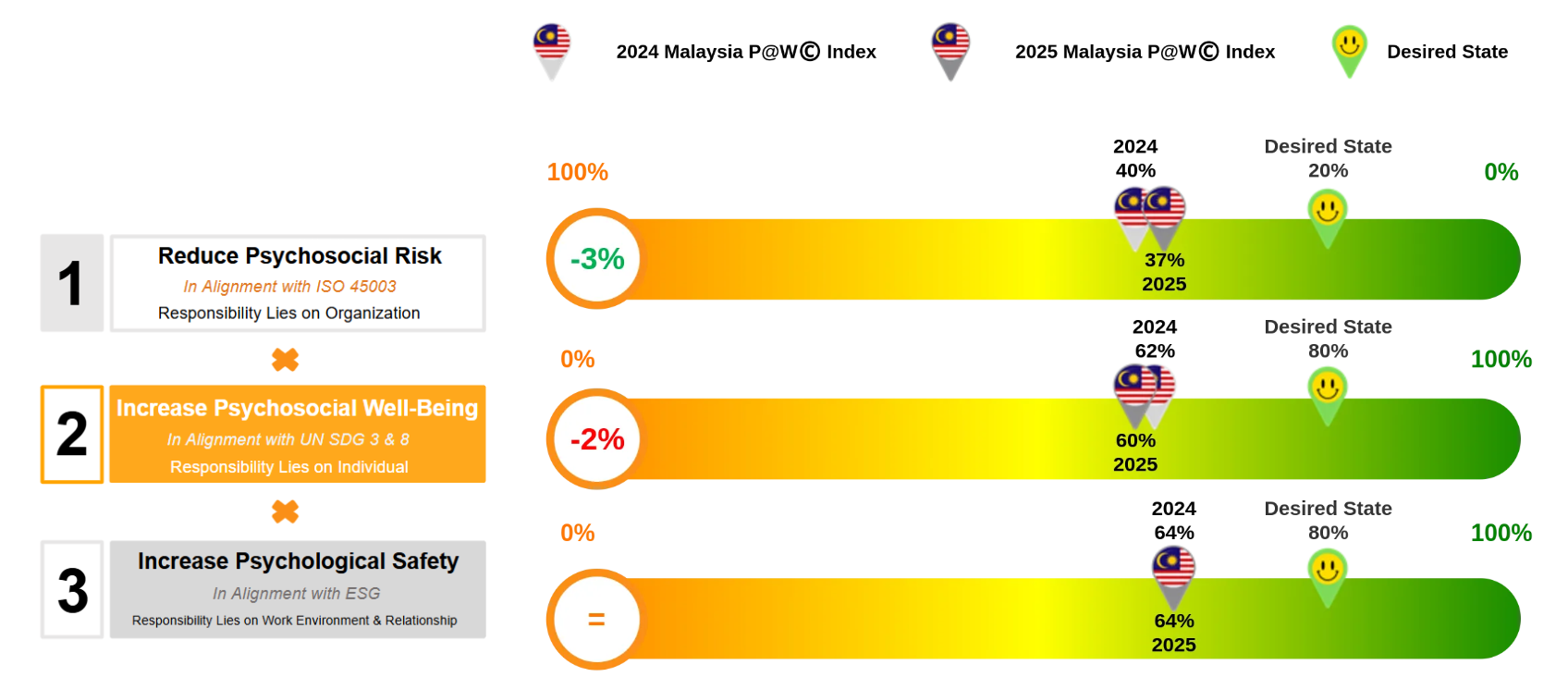
Findings: The 2025 Malaysia P@W©Index remains at 62%, unchanged from 2024. Psychosocial Risk score decreased by 3% to 37%, Psychosocial Well-Being decreased by 2% to 60%, and Psychological Safety remains at 64%.
How much pain and stress employees are experiencing
14 Items 20 Risk Factors
How well employees are managing their stress or pain
14 Items 3 Well-being Domains
Emotional Well-being
Social Well-being
Psychological Well-being
How safe employees feel to take positive action and be brave
7 Items 4 Safety Domains
Findings: The 2025 Malaysia P@W©Index remains at 62%, unchanged from 2024. Psychosocial Risk score decreased by 3% to 37%, Psychosocial Well-Being decreased by 2% to 60%, and Psychological Safety remains at 64%.
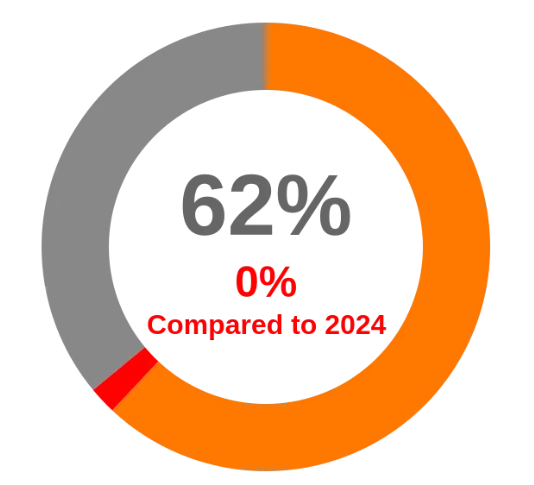
The 2025 Malaysia People@Work© was at 62%, this Index remain unchanged from 2024.
Female employees (61%) reported a lower P@W© Index compared to male employees (64%) by 3%.
Employees in the 31-40 yrs age group had the lowest P@W© Index at 59% while employees who are above 60 yrs were at 69%.
Executive employees (60%) have the lowest P@W© Index compared to Senior General Manager & Above (66%) by 6%.
In 2025, employees of less than 1 year tenure (61%) reported the largest decrease in P@W© Index scores by 2%.
While employees report higher role clarity and trust in management, they remain strained by the high pace and tempo of work.
Offensive behaviours have declined, but remaining harm becomes harder to detect as it concentrates within specific levels or teams
Employees feel increasingly disconnected from the broader purpose and impact.
Employees may feel included, yet hesitate to speak up, admit mistakes, or raise difficult issues.
Employees feel confident in their abilities but less secure in their sense of self-worth.
Employees may continue performing while becoming less willing to recommend or stand behind their organisation.
Workplace strain is not evenly distributed. It is more concentrated among females, mid-career professionals, and those in high-responsibility roles

"For too long, we have measured how people feel at work. The People@Work© Index challenges us to ask a far more meaningful question: How do we help people become the best version of themselves? That simple shift changes everything. More than an assessment, it empowers every individual to take ownership of their growth while helping teams and organisations bring out the best in one another. This is the kind of thinking the future of work needs."

"The future of organisational performance depends on how well boards understand and develop their people. I am encouraged to see workplace wellbeing receiving greater attention in boardrooms, and we must continue to recognise it as a strategic priority rather than simply an HR initiative. This means having meaningful dashboards and metrics to monitor progress, asking the right questions, and taking deliberate action to foster healthier, more resilient and high-performing workplaces."

"Understanding what truly drives our people: their growth, how teams work together, and how they perform is no longer optional; it's a business imperative. The People@Work© Index have given us the clarity to act on what matters most: personal development, team dynamics, performance, and overall wellbeing. It has become an essential part of our people strategy."

"Unlike traditional engagement surveys that typically focus on high-level sentiment, the People@Work© Index serves as a vital diagnostic tool, mapping the precise cause-and-effect between psychosocial risk, individual well-being, and workplace safety. The 2026 Index exposes the friction between organisational intent in reducing work stress and creating a psychologically safe environment versus actual lived experience. The data reveals a critical 'Courage Constraint': while employees feel a baseline comfort to belong, they lack the candor to speak up, share bold ideas, or challenge status quos. The challenge for organisations globally is now to recognise that psychological safety cannot just be a vertical policy between boss and reportee—it must be a lateral, practiced reality across peers. To unlock true organisational performance, leaders must bridge this gap, transforming passive comfort into active, psychological courage."

"Organisations need to move toward more relevant people metrics. Away from organisational ego metrics where the numbers make leadership comfortable and toward measures that tell us what’s actually happening: the extent to which we are building enterprise-wide self-awareness, genuinely accounting for intergenerational preferences, and actively protecting psychological safety. The People@Work© Index gives that shift a rigorous foundation. Where data can give more substantiation, organisations can have a validated tool that connects psychosocial risk, individual well-being, and psychological safety in one integrated read. That is not just better data. That is a fundamentally different conversation at the leadership table and to the wider ecosystem."

"The 2026 People@Work© Index makes one thing clear: our workplaces are becoming more efficient, but less connected. As AI and remote work reshape how we operate, we must not lose sight of the human fabric that holds organisations together. Social well‑being is now the new frontier of performance, and leaders must rebuild cultures where people feel seen, supported, and part of something larger than themselves."

"The People@Work© Index offers a more holistic and human-centred view by capturing employees’ lived experiences across interconnected dimensions, rather than relying on broad engagement scores. It surfaces nuanced tensions such as confidence without self-worth or safety without candour, that typical EES frameworks may overlook. While it remains personalised at the individual level, it still enables pattern recognition across teams, functions, and demographics, making it both diagnostic and strategic. This duality strengthens its value as a global index that reflects not just how employees feel, but how they function within their work environment."

"The People@Work© app is genuinely helpful and simple enough to use from the very first attempt. Having a quantifiable result has been key to convincing our directors and board to get on board with these types of programmes, it gives us the evidence to show how personal development, team performance, and well-being all tie together."

"As we move into the digitalisation era, it's more important than ever to keep humans human. The People@Work© Index allows us to deep-dive into the data with a soulful mind, the insights don't just tell us about people, but how we can work with each other in terms of well-being. It helps us understand how we can support one another, reduce pressure, and create a safe environment where everyone can grow, develop, and transform like a butterfly."

"People@Work© stands out because it goes beyond traditional engagement surveys to show how people truly experience work, while also giving individuals a personal report that helps them better understand themselves. Its greatest value is turning insight into action for both people and organisations, helping leaders listen more deeply, address root causes, and improve working lives with humility and urgency."