Introduction
People@Work© Index
The People@Work©Index
Psychosocial Risk
How much pain and stress employees are experiencing
“What’s Causing Chaos In Your 9 To 5?"
14 Items 20 Risk Factors
- Quantitative Demands
- Emotional Demands
- Tempo, Work Pace
- Influence at Work
- Possibilities for Development
- Meaning of Work
- Social Support from Supervisors
- Predictability
- Rewards (Recognition)
- Role Clarity
- Quality of Leadership
- Commitment to the Workplace
- Job Satisfaction
- Work-Life Conflict
- Vertical Trust
- Organizational Justice and Respect
- Stress
- Burnout
- Self-Rated Health
- Offensive Behaviour.
Psychosocial Well-being
How well employees are managing their stress or pain
“Are You At Your Best State to Score Goals?”
14 Items 3 Well-being Domains
Emotional Well-being
- Positive Affect
- Quality of Life
Social Well-being
- Social Contribution
- Social Integration
- Social Growth
- Social Acceptance
- Social Coherence
Psychological Well-being
- Self Acceptance
- Environmental Mastery
- Positive Relations with Others
- Personal Growth
- Autonomy
- Purpose in Life
Psychological Safety
How safe employees feel to take positive action and be brave
“Do You Feel Safe To Be Brave?”
7 Items 4 Safety Domains
- Inclusion Safety
- Learner Safety
- Contributor Safety
- Challenger Safety
2025 Malaysia Well-being@Work© Index Overview
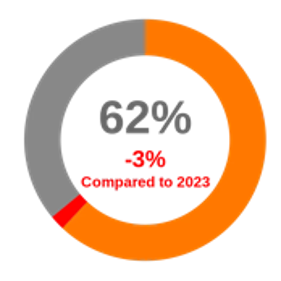
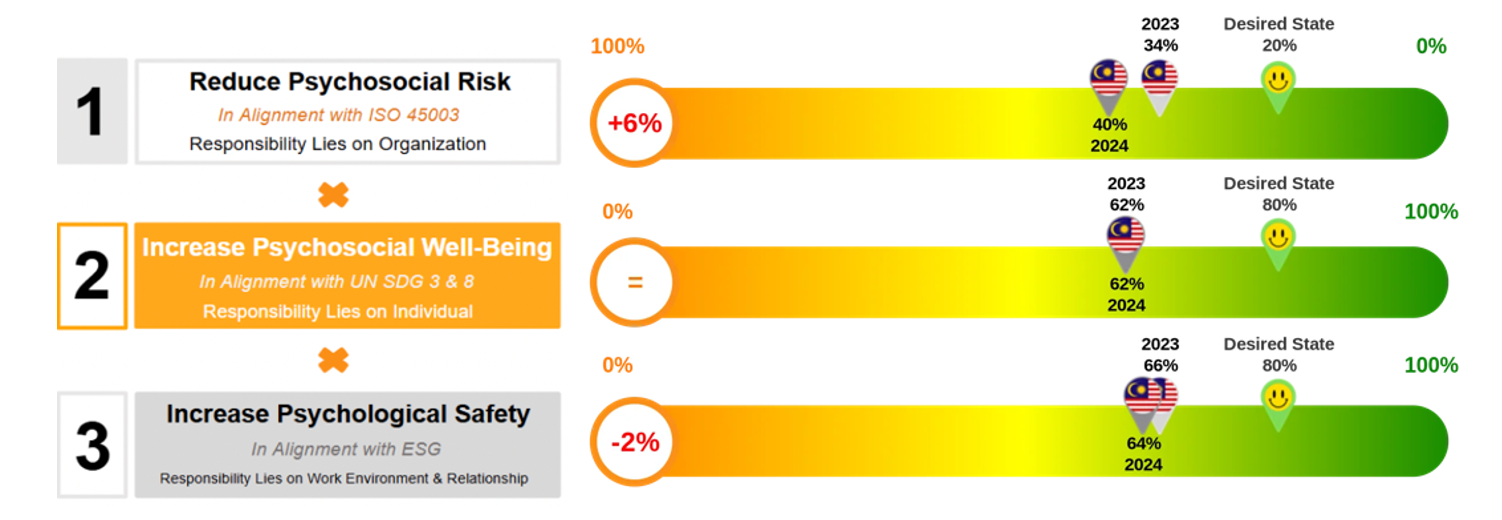
Findings: The Malaysia W@W©Index for 2024 has decreased by 3% since 2023. Psychosocial Risk score has increased by 6% from 34% to 40%, Psychosocial Well-being score has stayed the same at 62% and Psychological Safety score has decreased by 2% from 66% to 64%.
The State of Workplace Well-being in Malaysia
Index
The 2024 Malaysia Well-being@Work© was at 62%, this represents a decrease of overall Well-being by 3% since 2023.
Gender
Female employees (60%) reported a lower W@W© Index compared to male employees (63%) by 3%.
Age
Employees in the 18-30 yrs age group had the lowest W@W© Index at 60% while employees who are above 60 yrs were at 70%.
Job Level
Non-executive employees (58%) have the lowest W@W© Index compared to General Managers (69%) by 11%.
Tenure
In 2024, employees of 1-3 yrs tenure (61%) reported the largest decrease in W@W© Index scores by 3%.
Why This Report Matters
Track Year-on-Year Trends
Demographic Insights
Workplace Challenges & Risks
Actionable Recommendations
Who Should Read This Report
Government & Regulators
CEOs & Business Leaders
HR & Well-being Practitioners
Employees & Advocates
Quotes from Author and Partners

Hetal Doshi
"Workplaces drive economic growth, but if we neglect well-being, we face a human crisis. Progress means nothing if people are burning out, breaking down, or being left behind. The 2024 Malaysia Well-being@Work© Report reveals a stark reality. Well-being is in decline, with the most vulnerable groups being women, younger employees, junior staff, and those with lower tenure, bearing the brunt of it. Organizations must benchmark against the Well-being@Work© Index, while leaders and practitioners must elevate their Well-being@Work© literacy and skills. The future of high performance and thriving economies depends on our ability to achieve results without sacrificing human well-being or team dynamics."

Michele Kythe Lim
"The 2024 Malaysia Well-being@Work© Index Report proves that employee well-being isn’t just a perk—it’s the engine of performance, engagement, and innovation.ICDM urges organisations to use the W@W© Index for benchmarking, adopt best practices, and foster open communication. We remain committed to empowering leaders to build thriving workplaces where people and businesses can truly excel."

Sheikh Farouk Sheikh Mohamed Al-Bajrai
"The pursuit of wellness is both personal and collective. It means providing a safe workplace, innovative strategies for lifestyle change, and supportive public institutions. Through the Well-being@Work© Index, MEF partners with O-Psych to measure and benchmark workplace well-being, providing data-driven insights that empower organizations to drive meaningful, sustainable improvements."

YB Chong Chieng Jen
"Healthy minds create safer workplaces. At NIOSH, we emphasize the importance of managing occupational psychosocial risks to enhance well-being, productivity, and overall workplace safety. We support initiatives like the Well-being@Work© Index that contribute to workplace improvement, fostering a healthier and more resilient workforce."