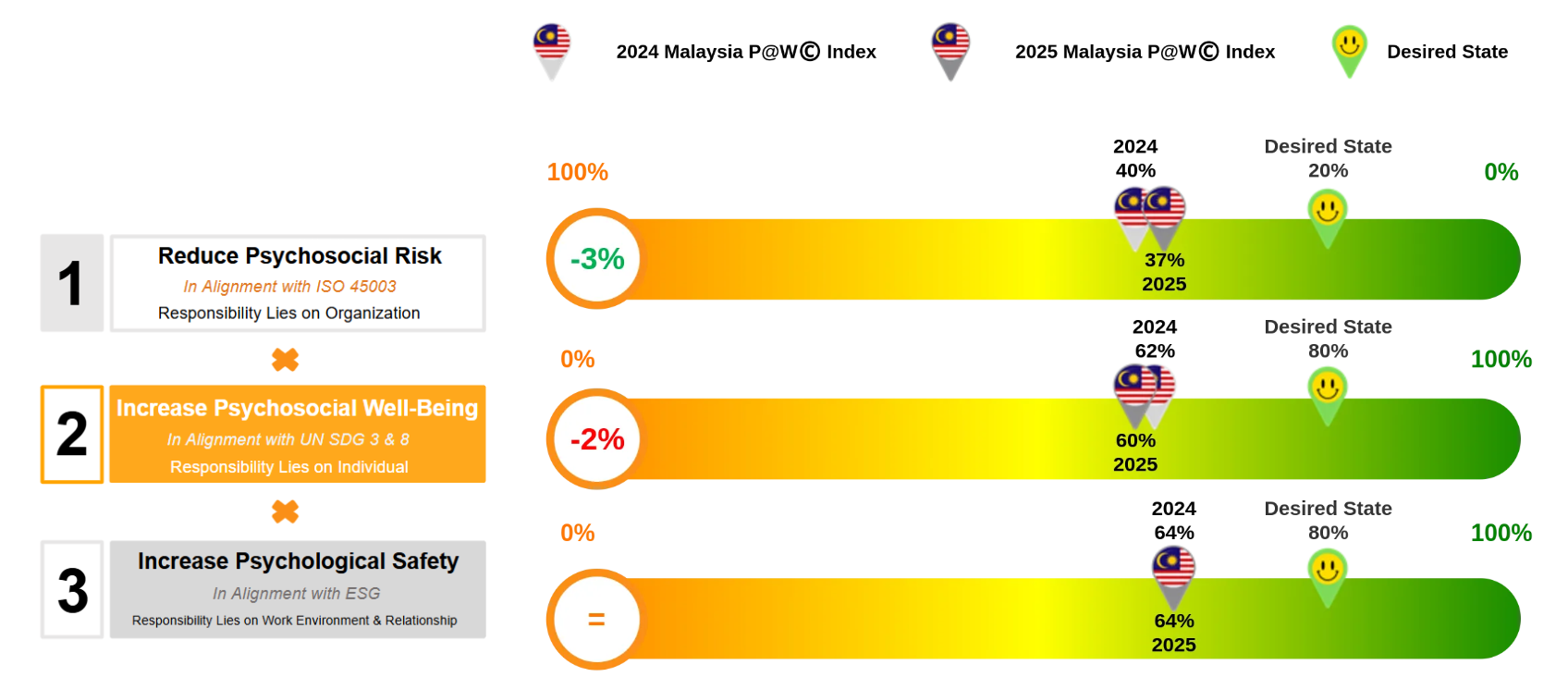
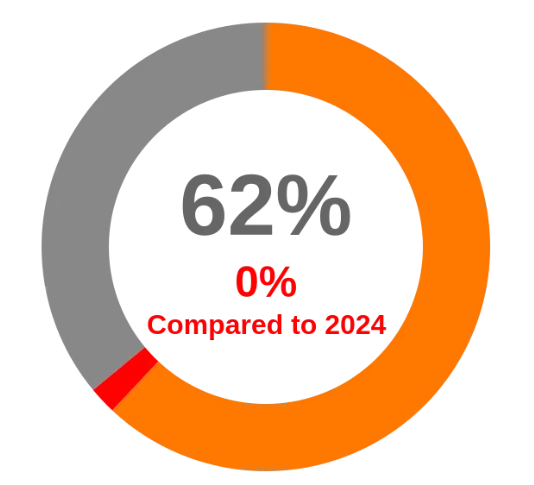
Findings: The 2025 Malaysia P@W©Index remains at 62%, unchanged from 2024. Psychosocial Risk score decreased by 3% to 37%, Psychosocial Well-Being decreased by 2% to 60%, and Psychological Safety remains at 64%.
How much pain and stress employees are experiencing
14 Items 20 Risk Factors
How well employees are managing their stress or pain
14 Items 3 Well-being Domains
Emotional Well-being
Social Well-being
Psychological Well-being
How safe employees feel to take positive action and be brave
7 Items 4 Safety Domains
Findings: The 2025 Malaysia P@W©Index remains at 62%, unchanged from 2024. Psychosocial Risk score decreased by 3% to 37%, Psychosocial Well-Being decreased by 2% to 60%, and Psychological Safety remains at 64%.
The 2025 Malaysia People@Work© was at 62%, this Index remain unchanged from 2024.
Female employees (61%) reported a lower P@W© Index compared to male employees (64%) by 3%.
Employees in the 31-40 yrs age group had the lowest P@W© Index at 59% while employees who are above 60 yrs were at 69%.
Executive employees (60%) have the lowest P@W© Index compared to Senior General Manager & Above (66%) by 6%.
In 2025, employees of less than 1 year tenure (61%) reported the largest decrease in P@W© Index scores by 2%.
While employees report higher role clarity and trust in management, they remain strained by the high pace and tempo of work.
Offensive behaviours have declined, but remaining harm becomes harder to detect as it concentrates within specific levels or teams
Employees feel increasingly disconnected from the broader purpose and impact.
Employees may feel included, yet hesitate to speak up, admit mistakes, or raise difficult issues.
Employees feel confident in their abilities but less secure in their sense of self-worth.
Employees may continue performing while becoming less willing to recommend or stand behind their organisation.
Workplace strain is not evenly distributed. It is more concentrated among females, mid-career professionals, and those in high-responsibility roles